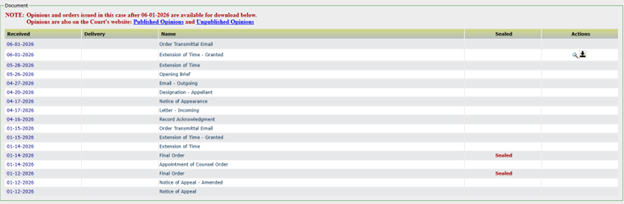
On June 1, 2026, the Court of Appeals introduced two updates to its Appellate Case Management System (“ACMS”) that will improve motions practice before the Court and allow litigants to better track their cases. First, each case now contains a docket report reflecting all pleadings and Court action. Second, the Court’s orders can be accessed through these docket reports.
Previously, ACMS only reflected the dates the Court received the case, the record, and each brief. It also provided the final disposition, with published and unpublished opinions available on the Court’s website; if a case resolved through an order, there was no way to access that order.
This limited information did not reflect any additional actions taken by parties and the Court during the pendency of a case, such as motions practice, deficiency notices and show causes, and court orders. With these latest updates, ACMS will now reflect these additional aspects of appellate litigation.
By way of example, consider CAV Record No. 0101-26-1. With this update to ACMS, we can see that the Commonwealth moved for an extension of time to file its responsive brief and that the Court granted that motion. While ACMS does not provide access to the motion itself, we can now access a copy of the order granting the motion (Note: only orders entered on or after June 1, 2026 are available).
Consider also CAV Record No. 1903-25-2. There, the opening brief was received in February, but the appellee did not respond until May. Previously, we would be left to wonder if the appellee’s brief was untimely. With these latest ACMS features, we can now see that the Court issued letters and show causes before ultimately dismissing the case. This provides some insight that the opening brief may not have complied with the Rules—and perhaps explains why the appellee did not respond in the normal course.
Until now, there was no way to see all pleadings filed in a particular CAV case and no way to access the Court’s orders. As a result, motions practice at the CAV has largely remained a “black box.” With these changes, we will be able to see what motions are filed at the CAV and how the Court resolves them, shedding light into this area of appellate practice for the first time. Additionally, this will allow parties to better monitor their matters with the Court. Particularly with the rise of pro se appellants following expanded jurisdiction who may not serve briefs and motions on the opposing party, these changes enable attorneys to be sure of what has been filed and when.
Example Docket Report on ACMS: